<img height="1" width="1" style="display:none" src="https://www.facebook.com/tr?id=114819295626675&amp;ev=PageView&amp;noscript=1">

7 min read

How Business Fuel Cards Work for Large Fleet Operations: Managing Fuel Cards at Scale

How Business Fuel Cards Work for Large Fleet Operations: Managing Fuel Cards at Scale

Managing fuel cards for a large fleet is different than managing them for a small business. The cards themselves work the same, but managing hundreds or thousands of cards, drivers, vehicles, and transactions requires a lot more organization.

Large fleets need to think about how accounts are structured, how cards are assigned, how fuel spending is reported, and how transactions are monitored. You also need a process for making regular account changes, integrating fuel data with other systems, and rolling out new cards across the fleet.

In this guide, we'll explain how business fuel cards work for large fleet operations and how to set up and manage a large fleet fuel card program at scale.

How Do Business Fuel Cards Work for Large Fleet Operations?

Fleet fuel cards work the same way for large fleets as they do for small businesses. Drivers use their cards to purchase fuel, transactions are recorded automatically, and fleet managers can set purchase controls and monitor fuel spending.

The difference is the amount of organization and fuel card management required as a fleet grows. Managing 20 fuel cards is relatively straightforward. Managing hundreds or thousands of cards across multiple branches, departments, drivers and vehicles requires a more structured approach.

Large fleets need to think about how their fuel card program is organized, who is responsible for managing different parts of the account, how purchasing policies are applied across groups of vehicles, and how thousands of fuel transactions are allocated for accounting and reporting.

For large fleets, the fuel card itself doesn't necessarily work differently. It's how the tools are set up and used at scale that changes. 

Centralized vs. Decentralized Fuel Card Account Management

If your business operates more than one location, one of the first things to determine is how you want to structure your fuel card account. Large fleets typically take one of two approaches: centralized or decentralized fuel card management.

The table below shows the main differences between the two.

  Centralized Decentralized
Account setup One account Separate accounts for each location
Invoice One invoice with expenses broken down by location Separate invoices for each location
Card management All cards are managed under one account Cards are separated by account, with users given access only to the accounts they manage
Who typically manages A fleet manager or small team at the corporate office Branch, location, or division managers


Which approach is better depends on how your business already operates. If your locations operate independently from corporate, a decentralized structure usually makes more sense. If most fleet decisions are handled at the corporate level, centralized management is typically the better fit.

Some large businesses fall somewhere in between. For example, you may have centralized accounting but decentralized fleet operations. In this case, each location can manage its own fuel cards while corporate accounting still has access to invoices across all locations or has them automatically emailed to the accounting department.

Structure Your Fuel Card Account Around Your Fleet

After you choose who's going to manage your fuel card account, it's time to structure how you want your transactions organized. Fuel purchases can then be summarized by region, branch, department, GL code or another cost center. This gives corporate managers visibility into total fuel spending while still allowing them to see where those expenses are coming from. Here are some examples.

Centralized fleet organized by location

Account - ABC Company
→ Los Angeles 
→ San Diego
→ Phoenix
→ Seattle

Centralized fleet organized by department

Account - ABC Company
→ Long haul
→ Local delivery
→ Sales
→ Management

Decentralized fleet organized by location

→ Account - ABC Company Los Angeles
→ Account - ABC Company San Diego
→ Account - ABC Company Phoenix
→ Account - ABC Company Seattle

Decentralized fleet organized by location and department

→ Account - ABC Company Los Angeles

→ Fleet
→ Sales
→ Management

→ Account - ABC Company San Diego

→ Fleet 
→ Sales

This structure becomes increasingly important as a fleet grows. Instead of manually separating thousands of transactions at the end of the month, the account can be organized around how the company already operates.

Consider Assigning Fuel Cards to Vehicles 

There are two main ways to assign fuel cards. You can assign cards directly to drivers with their names printed on the card, or assign cards to vehicles and give each driver an individual PIN they can use with any vehicle card.

For large fleets, assigning cards to vehicles makes card management easier. Driver turnover is typically higher than vehicle turnover, so assigning cards to drivers means canceling a card every time someone leaves and ordering a new card every time someone is hired.

With vehicle cards, the card stays with the vehicle while drivers are managed through individual PINs. When a driver leaves, you can simply deactivate their PIN. When a new driver is hired, you can create a new PIN and they can immediately use any vehicle card they're authorized to use. This reduces the number of cards you need to order, cancel, and replace as drivers come and go.

Fuel Reporting at Scale

Once you set up your account by branch, department, or another cost center and add your cards, vehicles, and drivers, the fuel card system can organize your transaction data into fuel reports. This makes it easier to manage thousands of transactions without manually sorting the data yourself.

You can run reports to see fuel spending by driver, vehicle, branch, department, or another category for a specific time period.

For example, if you want to see fuel spending by department, you can run a driver department or vehicle department fuel summary report. This lets you see total fuel spend by department along with the individual transactions for each driver or vehicle.

Check out our fuel card reporting guide to see the different types of reports you can run.

Make Sure It's Easy to Manage Your Fuel Cards

Managing a large fleet means you'll need to make changes to your fuel cards regularly. You may need to adjust limits, order or cancel cards, or add and remove drivers. Some fuel card portals can make these simple tasks complicated, while other providers may require you to call or email customer support to make changes. This can quickly become time consuming when you're managing hundreds of cards.

Look for a fuel card portal that allows you to make these changes yourself. Ideally, you should be able to log in, make changes within a few seconds or  minutes, and keep your fleet fueling without waiting on customer support.

Before choosing a fuel card provider, ask for a demo of their online portal so you can see how easy it is to manage cards and drivers. Some providers may also offer an interactive demo that lets you test the portal before signing up.

Use Fuel Card Alerts to Monitor Transactions

It's always a good idea to review your fuel card transactions regularly for signs of internal fuel theft or fraudulent activity. But when you're managing a large fleet, reviewing hundreds or thousands of transactions every day isn't always realistic. Fuel card alerts can help by notifying you when a card is used outside of its normal activity.

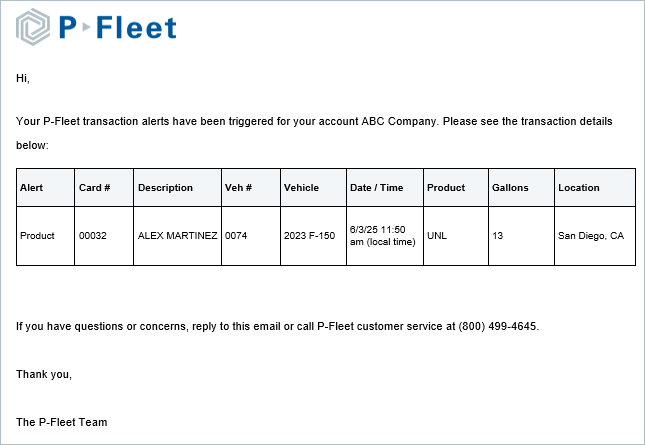
For example, you may have drivers who occasionally need to fuel after hours, so setting a strict time limit could result in legitimate transactions being declined. Instead, you can set an alert to notify you by email whenever a card is used after hours. You can then review those transactions to make sure it was a driver working late and not someone using the company card for personal fuel. Here's an example of a fuel card alert.

Fuel Card Alert

Integrate Fuel Card Data with Other Software

Many large fleets already use telematics platforms and ERP systems to manage their fleet operations and accounting. Some fuel cards offer built-in integrations with these systems, while others provide an open API that allows your developers to connect fuel card data directly to the software you already use.

Integrating fuel card data with your telematics platform lets you combine fuel purchases with mileage and vehicle data. This can make it easier to generate IFTA reports, identify potential employee fuel theft or misuse, and analyze vehicle fuel performance.

If you integrate fuel card data with your ERP system, fuel expenses can be allocated directly within your accounting system, reducing the need for manual data entry.

If you plan to connect your fuel card data to a telematics platform or ERP system, make sure the fuel card provider can integrate with the software your business already uses.

Setting Up Fuel Cards for a Large Fleet

Setting up a new fuel card account can be a challenge for fleets with hundreds of drivers and vehicles. Here are some steps to help make the process smoother.

How to Order New Fuel Cards at Scale

  1. Ask the new fuel card provider for an Excel or CSV card order form
  2. Download your existing fuel card list into Excel or CSV from your current fuel card portal
  3. Cross reference the vehicles on this list with the vehicles that are currently in your fleet to remove any inactive vehicle cards. If you use telematics, you will have an active vehicle list in that software.
  4. Cross reference your driver list with a current employee list to remove any drivers who are no longer at your company.
  5. Copy and paste the old fuel card list into the new fuel card order. You could also use your favorite AI tool to easily do this.
  6. Review controls to make sure they are appropriate for your vehicles 
  7. Send the fuel card order form to your new fuel card provider.

How to Hand Out New Fuel Cards 

This may sound simple, but it's easy to hand out a new fuel card without collecting and canceling the old one. Six months later, you could find charges on your old fuel card account because one of those cards ended up in the wrong hands.

When switching fuel card providers, make sure you collect and cancel old fuel cards as you hand out the new ones. There are two main ways to handle this for a large fleet.

Company-wide fuel card rollout

If possible, schedule a time when all your drivers and vehicles will be at the yard. Collect each driver's old fuel card and give them their new card at the same time. This is the easiest way to make sure every old card is accounted for before you switch over to the new program.

Pass out fuel cards one at a time

For many large fleets, getting every driver and vehicle to the office at the same time isn't realistic. Drivers may work different schedules, routes, or locations.

In this case, give drivers a set period of time to pick up their new fuel cards. As each driver comes in, collect their old card and give them the new one. Keep a list and check off each driver as they receive their card so you know who still needs one.

It's also a good idea to cancel each old fuel card as you collect it rather than waiting until you close the entire account. This prevents an old card from being used if it gets lost or ends up in the wrong hands.

Choosing the Right Fuel Card for Your Large Fleet

Fuel cards work the same whether you're managing 20 vehicles or 2,000. The difference is how you organize and manage the program at scale.

When choosing a provider, consider how easy the cards are to manage along with fuel discounts, fees, acceptance, integrations, and customer reviews. Our guide to the best fuel cards for large fleets compares these factors across the top options for larger fleets.

How to Choose Between Driver Fuel Cards and Vehicle Fuel Cards

1 min read

How to Choose Between Driver Fuel Cards and Vehicle Fuel Cards

When setting up a fuel card program, one of the first decisions you’ll make is whether to assign cards to your drivers or to your vehicles. There’s...
Read More
11 Cheapest Fuel Cards For Business Fleets in 2026: Comparison & Fuel Card Cost Calculator

1 min read

11 Cheapest Fuel Cards For Business Fleets in 2026: Comparison & Fuel Card Cost Calculator

Fuel card companies often advertise big discounts and rebates, but the card with the biggest discount is not always the cheapest. The price of fuel...

Read More
7 Best Universal Fuel Cards for Business in 2026

1 min read

7 Best Universal Fuel Cards for Business in 2026

Choosing the right fuel card can have a big impact on your business in terms of operational efficiency and cost management of your fleet. Universal...

Read More