<img height="1" width="1" style="display:none" src="https://www.facebook.com/tr?id=114819295626675&amp;ev=PageView&amp;noscript=1">
APPLY NOW
CONTACT US
11 min read.

CFN Fuel Card Review: Is it the Right Card for Your Business?

Jun 16, 2026 7:54:56 AM

CFN Fuel Card Review

The Commercial Fueling Network (CFN) is one of the largest commercial fueling networks in the Western U.S., providing access to 3,000 cardlock locations and 65,000 retail gas stations and truck stops nationwide.

What makes CFN different from most fuel cards is its cardlock network and cost-plus pricing model. Instead of paying retail pump prices, businesses can purchase fuel at prices tied to wholesale market rates, which can result in significant savings for fleets that regularly fuel at CFN cardlock locations.

In this CFN fuel card review, we'll break down how the CFN card works, where it's accepted, how much you can save with its cost-plus pricing model, the fees and controls it offers, and alternatives to help you decide if it's the right fuel card for your business.

Table of Contents

CFN Fuel Card: Overview

  CFN Fuel Card
Accepting Locations 3,000 discount cardlock locations; 65,000 gas stations and truck stops
Discounts Estimated 10-35¢/gal at discount cardlock locations (varies by card provider)
Monthly card fee (per card) $0 (varies by card provider)
Reviews Trustpilot: 4.7/5 (varies by card provider) 
Fraud protection Fraud detection, alerts, and fraud loss coverage
Controls Spend limits, restrict fueling days and times, fuel type controls, retail site lockout
Reporting Transaction detail report, real-time authorizations, and card reports


What Is the CFN Fuel Card?

CFN is a commercial fueling network owned by Corpay, and is comprised of 200+ independent companies called CFN marketers. These marketers own and operate CFN fueling stations and issue the CFN fuel card. When a customer signs up, they’re working directly with a marketer, who provides the CFN fuel card and manages account setup, pricing, customer support, and billing.

This setup is similar to how traditional credit card networks work. Visa and Mastercard provide the network and merchant acceptance, while banks and issuers handle the card program, customer service, billing, and account features. CFN provides the network and acceptance, while the CFN card issuer manages the customer relationship.

Where Is the CFN Fuel Card Accepted?

The CFN fuel card is accepted at 3,000 cardlock locations and 65,000 retail gas stations and truck stops. You can find nearby locations using the links below.

CFN Cardlock Locations

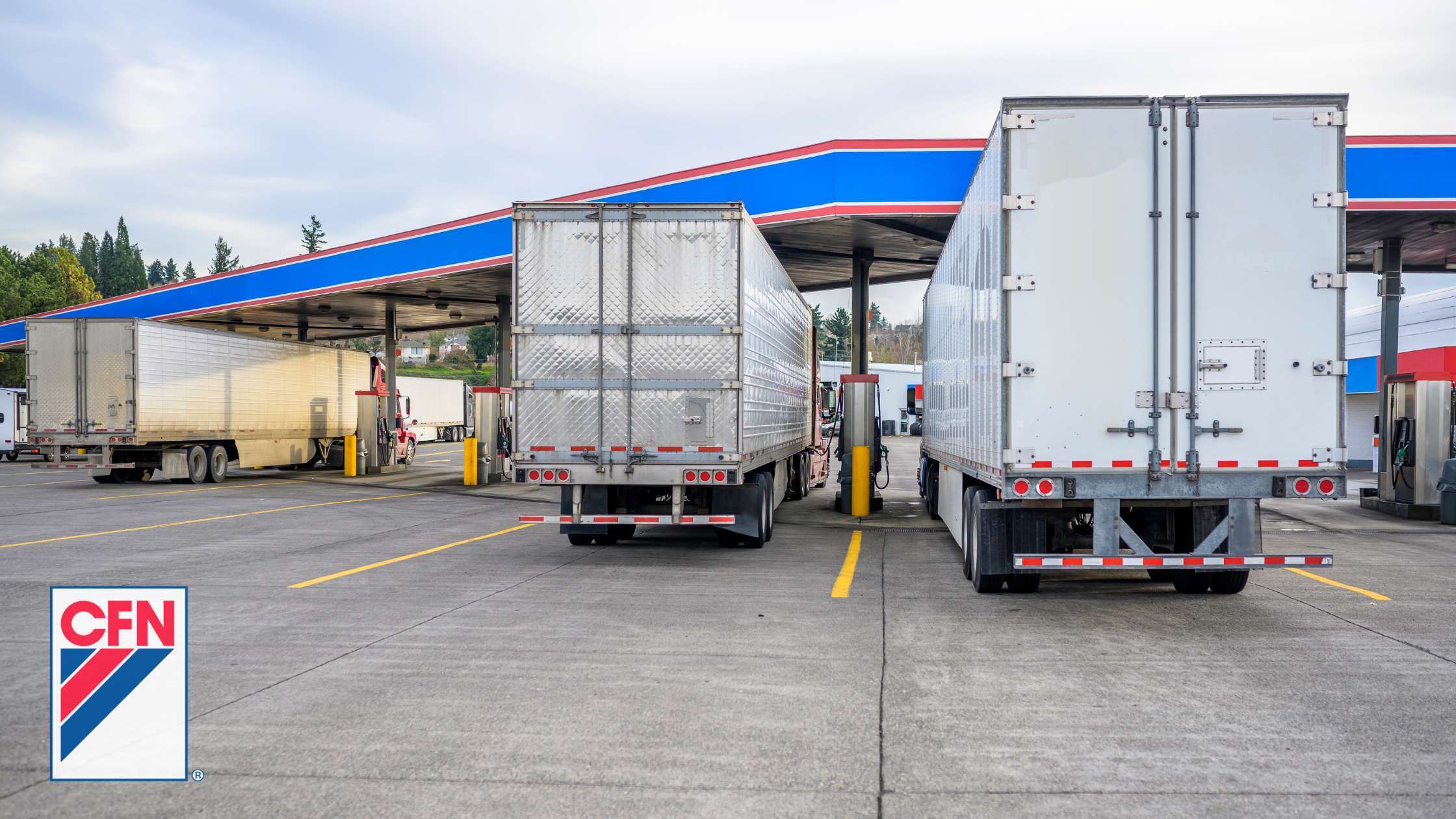
CFN cardlock locations are designed specifically for commercial fleets. Most sites feature oversized fuel islands, high-flow pumps, and access to products such as DEF and off-road diesel. Many locations are open 24/7, allowing businesses to fuel whenever it's convenient. Because cardlock stations primarily serve commercial customers rather than the general public, fleets often experience shorter wait times and faster fueling than at traditional retail gas stations.

Most CFN cardlock locations are concentrated in California, Arizona, Nevada, Oregon, and Washington, which makes it a great fuel card option for business fleets of all sizes that operate in these states.

Accepting Retail Gas Stations and Truck Stops

The CFN fuel card is also accepted at 65,000 retail gas stations and truck stops nationwide. Here are the brands that accept the card.

Accepted At All Branded Locations Accepted At Participating Branded Locations
ExxonMobil Shell
Chevron and Texaco Circle K
Speedway Valero
Love's 7-Eleven
Pilot Flying J Sunoco
TA 76
Sinclair Phillips 66
Arco BP
Murphy, Walmart, and Sam's Club Gulf
QuikTrip Citgo
RaceTrac and RaceWay Cenex
Maverick Marathon
Wawa Hess
Buc-ee's Amoco
Sheetz TA Express
Casey's  
Rutter's  
Kum & Go  
Quarles  
Kangaroo  
Mapco  
Fasmart  
Petro  
Jacksons  


CFN Fuel Card Pricing

CFN uses two pricing models: cost-plus pricing at CFN cardlock locations and retail pricing at gas stations and truck stops. On top of that, the CFN marketer that issues your card adds its own markup, which is how the marketer makes money.

As a result, the price you pay depends on both where your drivers fuel and which CFN marketer issued your card. To get an idea of potential savings, check out the quarterly CFN fuel price report, which compares CFN cardlock pricing to retail fuel prices.

Pricing at 3,000 CFN Cardlocks Pricing at 65,000 Gas Stations & Truck Stops
OPIS price + taxes + fuel card rate  Credit posted pump price
Estimated 10-35¢/per gallon cheaper than retail  Choose the cheapest available retail prices


Cost-Plus Pricing at Cardlock Locations

With the CFN fuel card, you get cost-plus pricing at cardlock locations, which is often 10-35¢ per gallon cheaper than nearby retail stations, depending on the market.

The CFN network prices fuel off Oil Price Information Services (OPIS) wholesale rack rates. OPIS publishes rack prices by region, and the “rack” is the fuel terminal where stations buy fuel in bulk. So if you’re fueling in San Diego, your price is based on the San Diego OPIS rack price, plus applicable taxes, plus your CFN marketer’s markup.

Retail Pricing at Retail Stations

At retail stations, your price is based on the posted pump price because retail station owners are in control of setting their own prices.

CFN Fuel Card Fees

Fees vary by CFN marketer because each provider can charge their own fees and pricing. When signing up for a CFN card, ask the provider if they charge monthly card fees, late fees, replacement card fees, or out-of-network fees. 

CFN Fuel Card Controls and Reporting

Controls

  • PIN/Driver ID: Custom number assigned to each card or driver. A valid PIN/Driver ID must be entered to enable fueling.
  • Transactions per day: Number of fuel transactions permitted on each card per day.
  • Gallons per transaction: Gallon amount a driver can purchase per transaction.
  • Gallons per day, week, or month: The number of gallons a driver can purchase in a day, week, or month.
  • Day of week: Days when a card can be used.
  • Time of day: Hours when a card can be used.
  • Product controls (cardlock locations only): The type(s) of fuel a driver can purchase.
  • Retail site lockout: Lockout retail stations by state so drivers can only use CFN locations.

Reporting

  • E-Receipts: Email alerts generated when a card is used.
  • Fraud alerts: Email alerts generated if suspicious activity occurs on your account.
  • Real-time authorization report: See all approved and declined authorizations in real time. 
  • Transaction detail report: See details for every transaction. Filter by time period, driver, vehicle, etc.
  • IFTA fuel report: Get total gallons purchased in each state by quarter.

Pros and Cons of the CFN Fuel Card

Pros

  • Cost-plus pricing model often saves companies money on fuel
  • CFN cardlocks allow drivers to fuel quickly without retail traffic and c-store distractions
  • More CFN cardlock locations than truck stops in the Western U.S.
  • CFN fuel card marketers provide more personalized support compared to large national fuel card companies

Cons

  • Limited cardlock coverage for companies not located in Western U.S.
  • Fewer accepting retail fuel stations than universal fuel cards

CFN Fuel Card Alternatives

The closest alternative to the CFN fuel card is the Pacific Pride fuel card, as it is the only other major cardlock fuel network in the U.S. While Pacific Pride has fewer cardlock locations than CFN which are primarily located in the Pacific Northwest, both networks are owned by Corpay and operate in a very similar way. They use a cost-plus pricing model, offer comparable fleet controls and reporting, and are designed primarily for commercial fleets. To see how the two compare, check out our CFN vs. Pacific Pride comparison.

If a cardlock fuel card isn't the right fit for your business, take a look at the best fuel cards for business to compare other options based on acceptance, discounts, fees, and customer ratings.

Broderic Fernow

Written by Broderic Fernow

Broderic is a marketing manager with more than a decade of experience in the fleet and fuel card industry. He specializes in creating helpful content and campaigns that help businesses simplify their fuel operations strategies.